Why Finding a Startup’s First Funder is Kind of Like Dating
To Jack Jorgensen, finding a Seed Round funder for his early-stage lawn care coordination platform Lumberjack Technologies was a bit like dating.
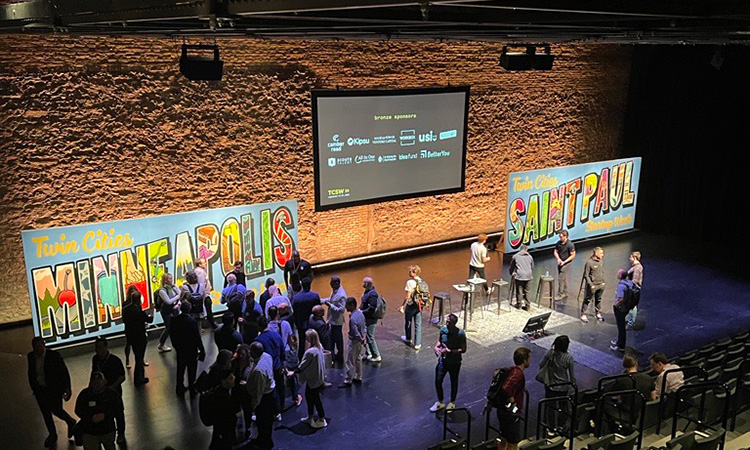
“It’s a little like trying to put yourself out there and see what sticks,” the company co-founder said during a Tuesday morning Twin Cities Startup Week panel focused on raising a startup’s first $500,000.
While venture capital financing for startups has dropped significantly within the last year and a half, Jorgensen shared how his company got to where it was despite facing a leaner funding market.
Executives from La Crosse, Wisconsin-based Idea Fund, which provided capital for Lumberjack, joined Jorgensen on stage at the Luminary Arts Center on Tuesday.
For Jorgensen, finding an investor, “was a volume game,” just like dating. “It was trying to reach out to as many funds as possible and establish those first connections and at least try to get a phone call or a Zoom meeting,” he told attendees. Starting in early 2022, Jorgensen began a 12-month search for funding for Lumberjack Technologies, a platform that coordinates, manages, and schedules local lawn, yard, and snow services. He said he reached out to around 50 to 75 funds. He received a response back of some sort, either to connect or decline, from only 25.
Among those interested in meeting with Jorgensen was Idea Fund. Garrett Lauderdale, VP of the fund, said their first “date” was at a coffee shop.
“I bought,” Lauderdale noted during the discussion panel, to which Jorgensen replied with a smile: “I owe you on that in the future.”
The relationship between Lumberjack and Idea Fund quickly became more serious. Within the next week, Jorgensen and Lumberjack’s other co-founder, Fin Simonds, met Idea Fund managing director John Horne. “I thought it made sense to start with first impressions to see how everyone was feeling within those first meetings,” Lauderdale said.
As far as Lauderdale’s first impression, he said he was interested in the way Jorgensen pulled from different experiences from his career and channeled that into Lumberjack. Jorgensen had previously worked for five years at UnitedHealth Group, but he’d also worked at a Brazil-based event ticketing startup. So, though his resume may have lacked continuity, he found his range of experience to be helpful when drawing on best practices for his own startup company.
Idea Fund specifically funds seed- and early-stage startup businesses across the region, so managing director John Horne noted during the discussion that “in this geography, I think has to be investing in people that haven’t done it before.”
For Horne, he said he’s less interested in the business itself and more interested in the person and people running it.
“Does this person have kind of the predisposition to what you need to do at this stage of business? I mean, going from zero to a million dollars a year in revenue is very, very difficult, a major major accomplishment,” he noted of Lumberjack’s early success.
And Horne acknowledged that the early stages of starting a business can be hard, lonely, and discouraging. It isn’t for everyone, he said.
For Lauderdale, he said these sacrifices meant he did not pay himself any money from his company for three years in order to get his business off the ground.
“This was a very conscious decision that I made with my wife in particular, so raising this round of funding allowed me to pay myself a very, very modest salary,” he said. “So the first meaningful thing that I did with that salary was I took my wife out to a very expensive dinner.”
At a separate VC “fireside chat” on Tuesday, a quartet of funders shared many of the same sentiments. Adam Choe, managing partner of Minneapolis investor Tundra Ventures, also said that finding funding is a “numbers game” that has many similarities to dating.
“You’re not going to find your true love, from a dating perspective, until you go on a lot of dates and make a lot of mistakes,” Choe said.
Choe said he often advises founders to keep two numbers in mind: 99 and 1. He said entrepreneurs seeking cash are likely to expect 99 “no’s” from every yes.
And, like Horne, Choe said venture capital is ultimately a person-focused endeavor over anything else. “The criteria for investment funds should be: People, people, people, people, and then whatever vertical you’re in,” Choe said.
He added: “The reason why friends and family invest in you first is because they have known you longest, so they have trust.”
Meanwhile, at the same fireside chat, Bread & Butter Ventures managing partner Mary Grove conceded that the picture for VC funding at the moment is “fairly grim.” But the industry ultimately follows a familiar cyclical pattern, she said. “We will weather the storm,” she said.