What ‘Local’ Means Today, and Why It Matters
I’ve just polished off the last crumbs at the bottom of the Sweet Martha’s cookie pail we brought home from the Minnesota State Fair (don’t tell the kids!). There is no better microcosm of what it means to be “Minnesotan” than our state’s unparalleled great get-together. We are butter and cheese and apples. We are galabao, Union Hmong Kitchen’s wildly popular steamed stuffed pastry. We are medical devices and manufacturing (you check out the exhibits, too, don’t you?). We are crop art and Nordic Ware Bundt pans and bamboo paddleboards made by local startup Paddle North. We are a thousand hats, T-shirts, and tote bags stamped with the outline of the state.
“I am a Minnesota artist. This is what people know me for. I’ve got to embrace that.”
—Artist and entrepreneur Adam Turman,
Ep. 118, By All Means podcast
Tameka Jones, founder of Lip Esteem, a plant-based lipstick line made in the Twin Cities, got the call in July that her State Fair application had been accepted. In six weeks, she built display booths, hired staff, made T-shirts (“The Great Minnesota Lip Together”), designed a sample kit of lip glosses on a stick, and stepped up production. Then she closed her St. Paul shop to work her new Grandstand booth for 12 straight days. The work was intense, exhausting, sweaty, and, ultimately, incredibly beneficial to this Black-owned small business, which received media coverage from the Fair and saw sales increase for the month—and likely, beyond, thanks to increased awareness.
That’s Minnesota.
Now that we’ve all digested, rested, showered off, and returned to our regularly scheduled lives, the Twin Cities Business team is thinking a lot about what it means to live and work in Minnesota. And why it matters—to our economy, workforce, property values, and all-around vibrancy. Are we maximizing our potential? Are we building companies that will be influential and innovative for generations to come?
It’s only in the last few years, thanks to technology and hybrid work, that our reporting team has had to fact-check whether a company that says it’s based in Minnesota really is. Sometimes, a founder calls Minnesota home, but the team doesn’t live here and manufacturing happens elsewhere. Is that a “local” company? Or, maybe, the company occupies offices in town, but its workforce is now dispersed around the country, or world. Are they “Minnesota” workers because their checks are written here? Are they tied into the community—volunteering, mentoring, judging the next startup competition? TCB’s digital editor Dan Niepow delves into an issue we’ll no doubt be sorting out for years to come (“The Meaning of HQ in a Hybrid World,” page 25).
On the flip side, GrandPad, a startup success story out of Hopkins, is going hyperlocal—to Wabasha, to be exact. Associate editor Tina Nguyen takes us to the tech company’s new office on Main Street and into the home of one of its devoted workers, who likes small-town living and zero commute time while connecting with customers around the world (“Leveraging Small-Town Nice, page 21). GrandPad, which sells tablets designed to make logging online simpler for seniors, has raised more than $31 million in its decade of business. But just about every founder and CEO we’ve talked to this year—from pre-seed to long-established—lamented how challenging it’s become to raise capital. Associate editor Winter Keefer breaks it down (“The Venture Capital Correction,” page 29).
Read more from this issue
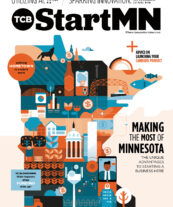
As a state-focused business news organization, Minnesota is the lens through which we filter all of our content, of course, but this issue of StartMN particularly focuses on all that makes Minnesota a dynamic environment for building business. We have an abundance of resources here, but another very Minnesotan characteristic: We often don’t do a good job of spreading the word beyond our borders—or, frankly, even connecting locally. We tapped into some experts who share advice on that front, too, from leveraging student talent to specific ways that corporations can better support startups.
While there’s nothing more Minnesotan than being “nice,” it’s time to really put some muscle behind it, and work productively—together.
A version of this column appeared in print with the headline “Feeling Minnesota.”