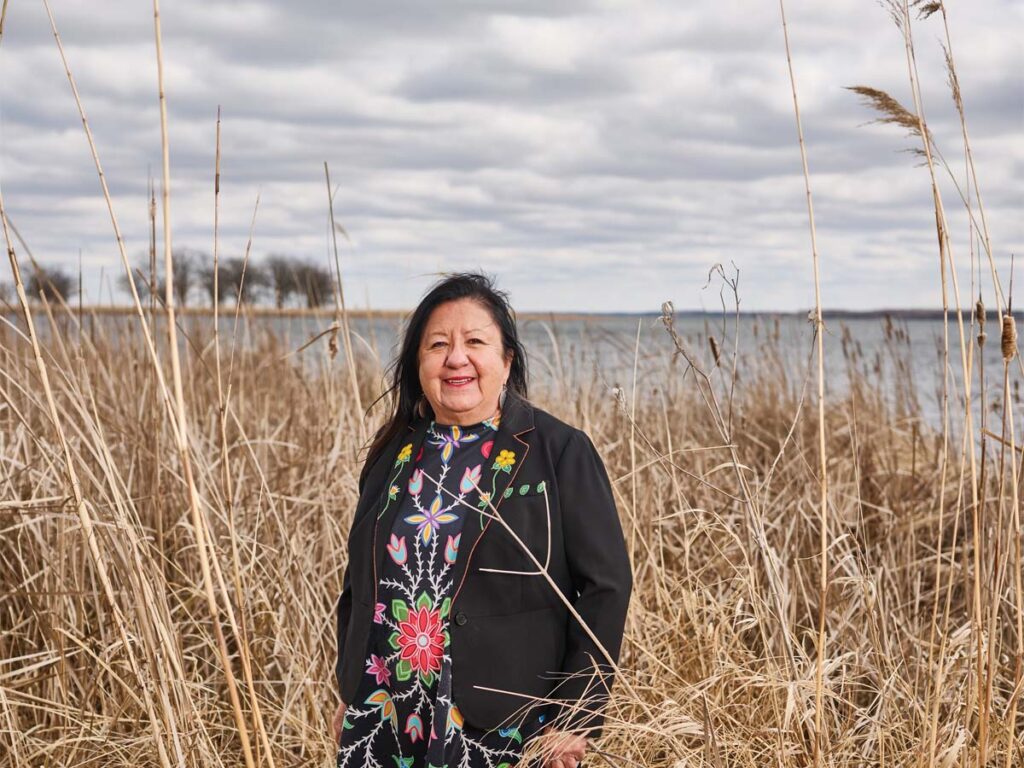
Melanie Benjamin
Growing up in a low-income housing project in St. Louis in the 1960s, Melanie Benjamin never thought she’d be a tribal leader in central Minnesota. When she was very young, she thought about one day working for the Peace Corps. Becoming an elected leader, she says, didn’t cross her mind.
“I never assumed I was that kind of person,” Benjamin says in an interview at her office on the Mille Lacs Band of Ojibwe reservation, about 100 miles north of Minneapolis.
Yet Benjamin has served as chief executive of the Mille Lacs Band for the past two decades, shepherding the tribe through rapid changes and challenges, and ushering in an era of prosperity for the next generation of Ojibwe. Under her leadership, the tribe has vastly diversified its business ventures beyond gaming.
And while the band’s 5,000 members have remained her top priority, Benjamin’s influence extends far beyond the reservation’s borders. Mille Lacs Corporate Ventures, the band’s business development arm, is the biggest employer of residents in Mille Lacs and Pine counties. These days, that entity is widely known for its two Grand Casino properties in Onamia and Hinckley, but it also operates hotels, a grocery store, a government contracting business, and, soon, a cannabis cultivation facility. In total, the ventures arm employs about 2,500 people, most of whom are not members of the Mille Lacs Band.
Benjamin’s counsel is regularly sought out by other tribal leaders and elected officials in Minnesota and around the country.
“She’s a leader amongst national leaders, and she’s respected,” says Susan Masten, past chair of the Yurok Tribe in Northern California, who’s served on boards with Benjamin. When Benjamin first entered the political realm back in the early 2000s, there weren’t as many women in tribal leadership, Masten notes.
“There were just a few of us, and today, there are so many more,” Masten says. “We hope that we were influential in other women running.”
“Her legacy will live on for generations because she has planted so many seeds of leadership.”
— Minnesota Lt. Gov. Peggy Flanagan
At the crossroads
Benjamin was born in 1956 in Siren, Wisconsin. At the time, her family was living in District III of the Mille Lacs Band of Ojibwe reservation, near Hinckley. In Ojibwe, the region is known as Aazhoomog, which means “crossroads.” Her father, a pulp cutter and U.S. Army veteran, traveled often for work and took Benjamin, her mom, and siblings along. When she was still very young, her family moved to St. Louis under what the federal government referred to as the “voluntary relocation program,” an assimilation program designed to persuade Native Americans to move off reservations and into big cities around the country.
The program was controversial, and its goals were largely unmet. Many Native people, including Benjamin’s family, would eventually return to their reservations. At 16, Benjamin and her mom moved back to their home up north. Benjamin was the fifth of 13 children.
Benjamin moved again a few years later. This time, the destination was Minneapolis, where, in her early 20s, she earned a clerk typist certificate from the Minneapolis Area Vocational Technical Institution, the predecessor of Minneapolis Technical College. Afterward, she landed a job as secretary-receptionist at the Metropolitan Economic Development Association, or MEDA.
Benjamin wanted to keep learning, so, in 1988, she earned a bachelor’s degree in business administration from Bemidji State University. Twenty years later, she would go on to earn a master’s degree in education from the University of Minnesota Duluth.
But first, she took a job as a business development specialist with the Minnesota Chippewa Tribe, a membership organization comprising the six Ojibwe bands within Minnesota’s borders.
She’d only worked there for a year when she was recruited by Arthur Gahbow, then Mille Lacs Band chairman, for a role with more responsibility: commissioner of administration. Benjamin says the job was essentially chief of staff for the band’s top leader. It was her first taste of tribal leadership. She held that role from 1989 to 1997.
In 1998, a group of elders again approached Benjamin and encouraged her to run for chief executive. “You don’t choose leadership; leadership chooses you,” Benjamin says.
That same year, with her elders’ encouragement, Benjamin launched her first campaign for the chief executive job. In the 2000 election that followed, Mille Lacs Band voters picked Benjamin as their new leader. She was only the second woman to hold the job (the first was the late Marge Anderson, whom Benjamin and many others counted as a mentor).
Benjamin herself would go on to mentor countless others across three decades. She was reelected as chief executive five times and remained in office, except for a four-year gap from 2008-12, when she was removed over accusations of misspending tribal funds. Benjamin has denied any wrongdoing. These days, she looks back and chalks it up to the fraught nature of politics. “There’s not one elected leader that hasn’t faced some kind of attack,” she says.
Voters were evidently willing to look past the accusations, reelecting her in 2012, 2016, and 2020. In 2024, Benjamin announced that she would not run again. “Now it’s time for somebody else,” she says.
Scott Vele, executive director of advocacy group Midwest Alliance of Sovereign Tribes, says that Benjamin has always seen beyond her own reservation’s boundaries and has regularly shared indispensable guidance with other tribes in the region. “When she says something, the room goes quiet and everybody listens,” Vele says.
‘Auntie energy’
Timeline
1956: Born in Siren, Wisconsin
1988: Earns bachelor’s degree in business administration from Bemidji State University
1989: Becomes commissioner
of administration under Mille Lacs Band of Ojibwe chairman
Arthur Gahbow
1998: Launches campaign for chief executive
2000: First elected chief executive
of the Mille Lacs Band of Ojibwe
2024: Announces plans not to
run again
Benjamin’s resilience and perseverance in the face of adversity have made her a widely respected figure on and off the reservation. “She’s got big auntie energy,” says Terri Thao, program director of local initiatives and opportunities with Eden Prairie-based Margaret A. Cargill Philanthropies.
The two serve on the Minnesota Housing board of directors, where Benjamin was first appointed in 2019.
“I really appreciate her style of quiet but firm leadership,” Thao says.
Minnesota Lt. Gov. Peggy Flanagan is one of many Native women who’ve counted Benjamin as a mentor over the years. Flanagan, too, describes Benjamin as an “auntie” to herself and many others.
“I likely wouldn’t be lieutenant governor without her belief in my abilities and support along the way in my career,” Flanagan says. “She is unstoppable because of the investments she makes in other leaders.”
As Benjamin sees it, that’s all part of her duty as a tribal leader.
When she announced plans not to run again this year, she said that “one of the most important jobs of any leader is to prepare the next generation to take over.”
Sitting in her office and reflecting on her political career, Benjamin reiterates the importance of nurturing future leaders. “At the end of the day, I believe that everybody has a gift,” she says. “It’s our responsibility to find out what that gift is, and to promote and share that gift for the best of the community.”
See the other 2024 Minnesota Business Hall of Fame inductees.