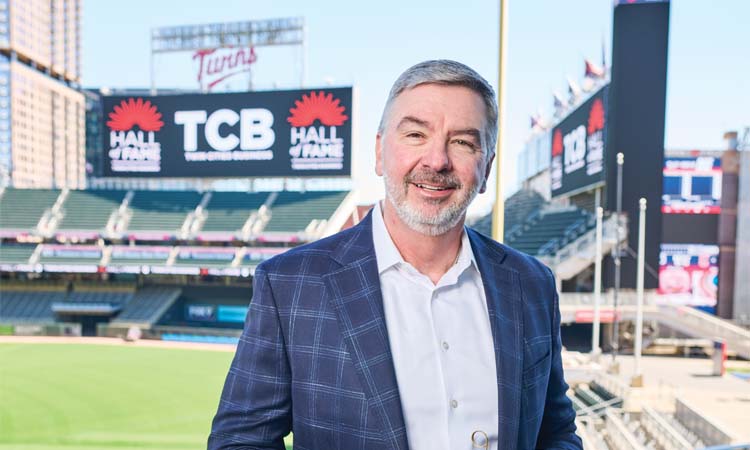
Jim Snee
Of Minnesota’s 17 Fortune 500 companies, just a couple are based outside the Twin Cities. At No. 343, with $12 billion in annual revenue, Hormel Foods is about two hours south in Austin, a small town also known for its Spam Museum, which waltzes visitors through a history of Hormel’s iconic canned lunch meat.
The story goes that Hormel, founded in 1891, turned down bigger-city offers to favor local farmers. Meat has long been at the center of the company, with Jennie-O turkey, Hormel Chili, and Black Label Bacon as some of the company’s best-known brands.
But times change. Industries fluctuate. President and CEO Jim Snee knows this well. When he became CEO at the end of 2016, the country was catching on to meat alternatives. (The Impossible and Beyond burgers debuted that year.) The meat side of Hormel was also taking up a “disproportionate amount of time,” Snee says. “The commodity part of your business is subject to things outside your control”—volatile market conditions, the weather, and disease outbreaks.
The company wanted to focus on the value-added side, he says. It’s more predictable, less exposed, and it now makes up 90% of Hormel’s business. A longtime meat packing company, Hormel has moved away from meat-centrism. Some plant-based additions over the past couple decades include nut butters (Skippy, Justin’s) and guacamole (Wholly).
This transition took several years to achieve. The metamorphosis wasn’t broadly recognized because the company lacked that “big get.”
That is, until Snee clinched it: In 2021, he pulled the trigger on a $3.35 billion purchase of the Planters snacking portfolio from Kraft Heinz Co. The mega-brand became the largest acquisition in company history. It packed in other convenience-store grabs, like NUT-rition and Corn Nuts. “It put us in a mindset that said, ‘OK, we can be a snacking company now,’ ” recalls Scott Aakre, a group vice president and chief marketing officer at Hormel. Snee “saw the vision and knew how to manage the risk appropriately.”
Under Snee, the company cemented its mission as a “global-branded food company.” It’s not all commodity-based; it’s not all packaged goods, either. (And for the “global” part, revenue today comes in from more than 80 countries.)
Snee is quick to stress that the evolution was incremental. “It’s not like we took a 180-degree turn and took the company in a different direction.” In person, he matches Hormel’s small-town ethos. “When he speaks, he doesn’t pound the table—he’s quiet in his observations,” says Julie Anna Potts, president and CEO of the D.C.-based Meat Institute, of which Snee was named chair in January. “People are like, ‘Oh, that was an excellent insight!’ ” she says.
“He’s demanding, but he’s fair, and everyone that works for him trusts he’s giving you the right story, the straight story.”
—Scott Aakre, chief marketing officer, Hormel Foods
Today, seated at the head of a conference table at the Austin headquarters, he’s looking back. He retires in October, at the end of the company’s fiscal year, then will stay on as a strategic advisor for 18 months. He will have guided nearly a decade of significant changes at Hormel. Aakre points to two major leadership moments that have defined Snee’s nine-year tenure: One is the Planters deal. The other is his handling of circa-2020 fallout.
The son of a garbageman—“a respectable, blue-collar job that supported a family of five kids,” he says—Snee, who grew up in New Mexico, was the first in his family to go to college. He earned a marketing degree at New Mexico State University (and later an MBA at the University of St. Thomas). “I’d be in a sales position,” he’d thought, “and maybe move into a marketing job and, at some point, be a manager.”
He picked Hormel after he went to an on-campus interview. Why? Competitive compensation, a company car—and, at the time, a California office. He hadn’t pictured himself taking the helm about three decades later.
But he worked his way up, starting in sales in 1989. In 2011, he took on the international business division. He became CEO in time for immense disruption. “I don’t know that there’s a full appreciation of what companies had to go through,” he says, referring to the pandemic.
He recalls a multitude of urgent problems with an accompanying lack of easy solutions—having to lobby multiple levels of government for personal protective equipment for Hormel’s shoulder-to-shoulder plant-based workforce and feeling an urgency to keep grocery shelves stocked. “In Jim’s mind, it was, ‘How do we keep food on people’s tables, that we’re delivering product to our customers?’ ” Aakre recalls. “ ‘How do we make sure we are paying our people? And most importantly, how do we keep everybody safe?’ ” Snee notes, “We fulfilled our obligation on all three of those things.”
Hormel avoids management layoffs, Snee says, because they keep the upper ranks lean—“we don’t just blindly add jobs.” But it was apparent Hormel could restructure itself.
The company adopted a three-year plan in 2023 to “transform and modernize.” Former group vice president Steve Lykken called it “the most significant undertaking” in company history. It wasn’t a direct response to the pandemic; the company had been wanting an upgrade. Covid-19’s global chokehold delayed those efforts—but Snee says it also taught Hormel a lot about supply-chain efficiencies.
About Hormel
- Best-known brands include Jennie-O, Planters, Skippy, and Spam.
- The company, founded in 1891 as Geo. A. Hormel & Co., says it developed
the world’s first canned ham, in 1926. - Hormel’s first “legacy products” were Dinty Moore beef stew, Hormel Chili,
and Spam, introduced between 1935 and 1937. - Today, more than 40 of Hormel’s 47 brands hold the No. 1 or No. 2 share
in their categories. - Hormel produces more than 90 million jars of Skippy peanut butter each year.
The plan would zero in on those efficiencies, aiming to streamline Hormel’s global supply chain. It has involved connecting company data systems, optimizing Hormel’s portfolio of product offerings, and deploying AI for demand planning. The latter tool is meant to replace “countless hours of human calculation,” according to the company—without replacing humans. “It’s really about making the workforce better,” Snee says.
He feels good about readying Hormel for its future, but he’s also eager to discuss community-based work “underneath all the business we do.”
In 2020, Hormel introduced a program, Inspired Pathways, that entitles all team members’ dependents to a free two-year college education. It coincided with the racial reckoning that occurred in response to George Floyd’s murder in Minneapolis. The examination called attention to racial disparities, including in education. In 2024, Hormel Foods opened a childcare center that serves children of employees and area families. Hormel was also a leader in forming the Hometown Food Security Project.
The golden rule (“Do unto others as you would have them do unto you.”) informs Snee’s leadership—likely part of what colleagues describe as his humanity and spirit of service. Austin residents “see Hormel as the friend down the street,” Aakre says. A Snee family mantra is “Leave it better than you found it.”
Hormel reports it has grown from $9.5 billion in net sales in 2016, the year Snee became CEO, to about $12 billion today.
The “transform and modernize” plan is set to wrap in 2026, and that timing has led to some raised eyebrows at Snee’s exit. “It gives the next person adequate time to think about what’s next,” Snee reasons. He says aligning the next CEO’s entry with a major initiative’s close “doesn’t seem fair.”
This sentiment echoes Aakre’s characterization of Snee: “He’s demanding, but he’s fair, and everyone that works for him trusts he’s giving you the right story, the straight story.”
It seems clear that beneath Snee’s affability, he possesses a lot of fight—fight to keep workers top of mind, to whip operations into shape, to move the company ahead. His business philosophy calls back to an athletic youth. “You have to have that level of competition,” he says, even-keeled as ever. “That’s that desire to win.”
See the other 2025 Minnesota Business Hall of Fame inductees.