EVS Inc.
Headquarters: Eden Prairie
Inception: 1979
Family name: Kim
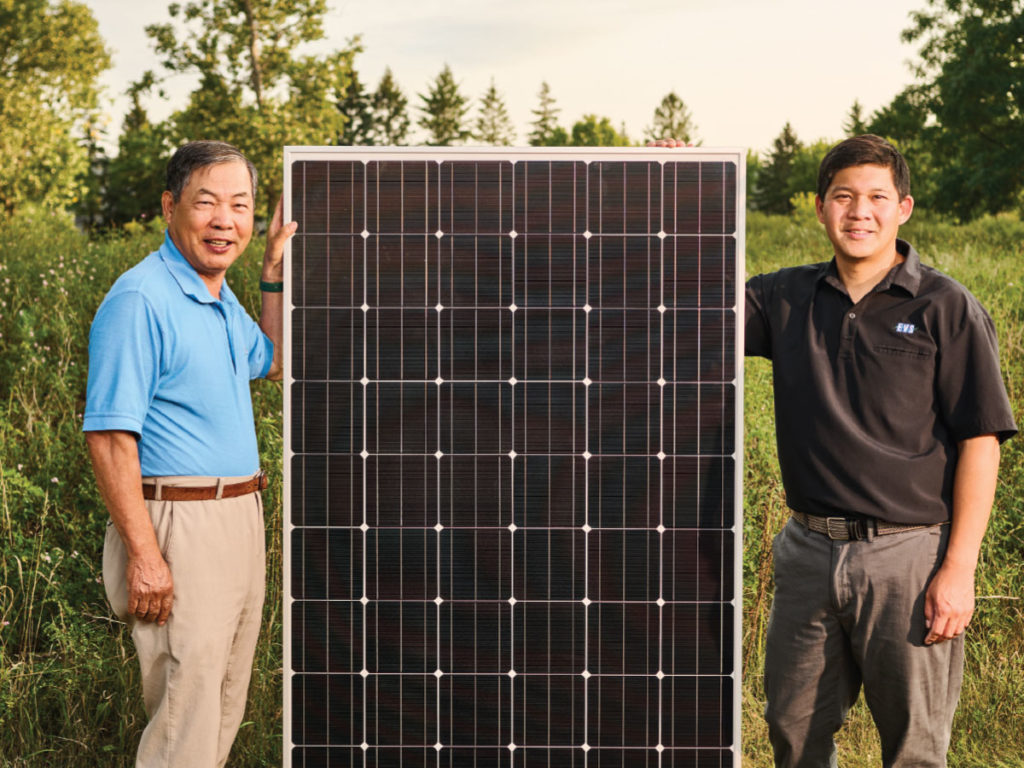
What the company does: EVS is an engineering firm that specializes in designing large-scale solar energy and battery storage projects throughout the country.
Type of ownership: S corp. and family trust
Principal owners: Andy Kim and Dennis Kim
Employees: 125
Family members in the business: 2
Family members on the board: 2
“We don’t have obligations to outside shareholders to maximize profits, so we can make decisions that prioritize our people.”
-Andy Kim, President
After completing his military service in Korea, Dennis Kim came to the University of Minnesota in 1969 to study engineering. More than 50 years later, he’s still in Minnesota, and he’s a principal owner of an engineering firm that now focuses its growth on solar energy projects.
Kim’s ownership of EVS Inc. dates back to the early 1980s, when the civil engineering firm focused on highway, road, and parking lot projects. Growth plans for EVS were linked to the public infrastructure needs of communities, and the projects relied on the availability of government funds.
Kim, the chairman of Eden Prairie-based EVS, and his business have experienced both prosperous and lean years, often linked to the cyclical nature of the economy and changes in government spending.
One of the biggest challenges the company faced occurred after the Great Recession hit in 2007.
“Every month, we are losing money. Then one person leaves and another person leaves—they kind of saw the ship is sinking,” recalls Dennis Kim. To stay afloat, Dennis had to cash out his retirement funds, mortgage his house, and use his entire line of credit with his bank. “I put everything into the company. We hit rock-bottom, there’s no other place to go down,” he says.
Teresa Lassegard, director of project administration and a 30-year EVS employee, describes Dennis’ work ethic at this time. “Dennis would come in, and you could see he hadn’t slept [well] in three weeks, just trying to figure out what to do, calling our clients, and seeing if they could pay us ahead of time because payroll is coming out.”
With the traditional civil engineering market oversaturated with competitors, wind energy became top of mind for Dennis as he decided the company’s next move, says Dennis’ son, Andy, current EVS president. But EVS discovered the wind energy market was too mature for newcomers. Instead, within two to three years, the market opportunity for solar energy was a good one for EVS.
At the time, solar energy was a small, developing market. Lassegard compares the switch to solar to being in the Wild West—a free-for-all, with no established rules. “I didn’t know if Dennis was brilliant or crazy,” she says. Stephen Hansen, senior vice president, says it was a leap of faith, but it was one reason he decided to join EVS in 2016 after building the solar group at his previous employer.
“Dennis and I were friends, and I noticed that he, frankly, had struggled for many years. And I didn’t think it was right, that a person of this caliber would have to struggle as he’s getting older,” Hansen says. EVS didn’t just gain Hansen’s loyalty, but also his large network of trusted clients, which greatly increased the company’s work portfolio. “I trusted us to do the work, and we did the work,” he says.
EVS began with small solar projects, and after finding success in those, branched out into larger, nationwide projects. Now, EVS is one of the largest privately held renewable energy design firms in the country, growing 30% each year, with much of its revenue coming from solar battery storage and renewable energy.
“We are playing a major role in accelerating the transition to renewable energy,” Andy says. The current market for renewable energy is expanding, and project demand is set to increase because of climate change mitigation efforts. “But it doesn’t even have to be about climate change. The fact of the matter is, this industry is growing. And it’s booming because there are so many people,” he says.
Yet EVS doesn’t focus solely on solar; it still does a variety of civil engineering work, including a contract for the huge U.S. Bank Stadium in Minneapolis that opened in 2016.
“We don’t have obligations to outside shareholders to maximize profits, so we can make decisions that prioritize our people and prioritize what we believe in,” says Andy.
That people-first mentality further manifested itself at the outset of the pandemic, just three months into Andy’s tenure as president. About $1.4 million in anticipated project revenue quickly vanished when Covid-19’s economic harm was spreading. But EVS leaders decided that cutting employees was not an option. Instead, the firm leveraged its network and made 30 calls in a week, resulting in new projects that could recover half of that revenue.
Since doubling its employee numbers in recent years, EVS now employs 125 people. The company generated $18 million in revenue in 2021 and is on track to reach $25 million this year.
The Kim family takes pride in the firm’s people-focused culture. Leaders build personal relationships with employees through Monday meetings where they share good news. The EVS CARES Foundation funds many nonprofits, including those supporting education and hunger and disaster relief.
“Our belief is if we put our people first, if we put our clients first, then profits will follow. And I think that mentality turned out to serve us much better than we could have ever expected it to,” Andy says. “This company doesn’t exist to necessarily make money for the owners. It exists because we have a strong belief in renewable energy, and we have a strong belief in helping the people here be successful. Just as Stephen came to help my dad and me, we want to do the same for everybody else.”