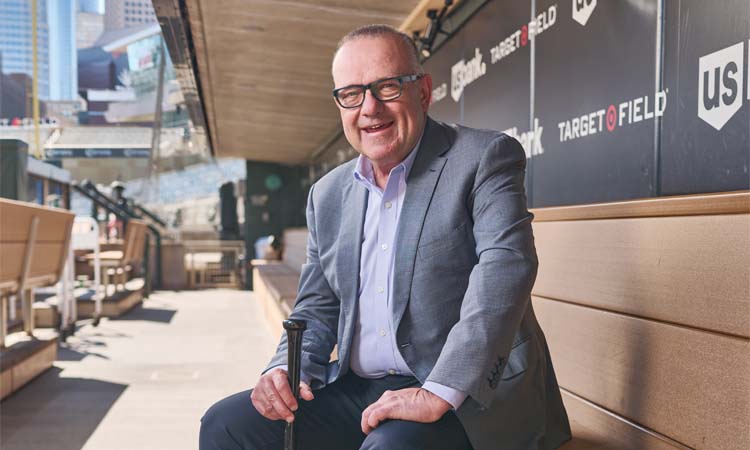
Dave St. Peter
Right before Thanksgiving 2002, Dave St. Peter was summoned to a meeting with Minnesota Twins owner Carl Pohlad. He had been with the organization for just about 11 years. “I was told I was the next president of the team,” he recalls. “I told them I’d do my best.
“I was thrown into the deep end of the pool,” continues St. Peter. “There were days I wished I had taken more business classes. But I had great mentors.”
St. Peter joined the organization in 1990, following an internship with the NHL Minnesota North Stars after graduating from the University of North Dakota in 1989. A product of Bismarck, North Dakota, he had envisioned himself in sports journalism or sports PR, not running a major-league baseball team. He did not start out at the C-suite—during the World Series year of 1991, he managed the team retail store in Richfield.
St. Peter turned over the president’s job to Derek Falvey in March, and as he prepares to leave the organization—but not retire—at year’s end, the sweep of his tenure and the team’s evolution stands out.
“He cares more about the team than himself.”
—Derek Falvey, president, Minnesota Twins
Evolution and modernization: In 2002, St. Peter inherited a major-league business that had a distinctly minor-league footprint. In 2006, when the Target Field bill passed the Minnesota Legislature, “we began to modernize a business operation that has continued to evolve. From playing in a corner of a football stadium to designing, building, and operating Target Field.”
St. Peter’s goal was to maintain a fully integrated organization without a moat between business and baseball. He says he is especially proud that the two are aligned in the organization, not walled-off verticals as are common across MLB.
A decade later, in 2016, St. Peter partnered with Falvey to lead the organization through an evolution of its baseball operations, into the era of data-driven everything. “It was an equally significant undertaking and changed the culture of the organization,” he notes.
Falvey recalls looking for former Twins executives to speak with as he contemplated moving from the then-Cleveland Indians. He had a hard time finding anyone: “There’s so many long-tenured people here, and that’s a reflection on Dave. That continuity is atypical in MLB.”
As the organization changed, so did St. Peter. “The first 10–15 years,” he recalls, “I was not an effective manager of people. I was difficult to work for. I became more of an empathetic leader because I wanted to be respected.
“The best leaders find a way to harness their emotions,” he continues. “I tell our leaders to model the behavior you’re looking for. It’s especially important in sports because it’s so volatile.”
St. Peter’s growth as an executive was evident to his direct reports. “Dave really evolved,” says Falvey. “Not many leaders so deeply ingrained in an organization are capable of that kind of evolution.”
St. Peter’s Highs and Lows
High Points
- 1991: World Series run
- 2006: Ballpark bill passes
- 2006: Playoff clinching as the Royals lost
- 2009: Game 163 vs. Detroit
- 2010: Target Field opening day
- 2023: Breaking playoff losing streak
Low Points
- 2002: Explaining contraction to retired players
- 2004–06: Final troubled years of Kirby Puckett’s life
- 2008: Losing game 163 in Chicago
- 2016: Cutting ties with longtime general manager Terry Ryan
- 2020: Covid
- 2004–22: “I probably owned 0–18 in the playoffs more than anyone in the organization.”
Broad focus: St. Peter’s stamp on the Twins is most evident in three areas. First, he reconnected a franchise that dates to 1891 to its history, rebuilding frayed ties with great players of the Griffith-ownership era and instituting a team Hall of Fame. “We were estranged from too much of our history,” he notes.
Second, as a Dakotas native, he understood the team’s reach and importance in the Upper Midwest and enhanced its profile in “Twins Territory.” Third, he made community a priority of his tenure. “We prioritize accessibility, we are engaged civically, and in times of crisis we show up,” he says. He made the team’s community exec a direct report.
Authenticity and effort: St. Peter has mellowed, but he remains authentic in an era of façade. “He’s right in front of you. He doesn’t pull punches. He’s a real person,” says Minnesota Wild CEO Matt Majka.
Although he admits to paying a personal price for it, “I don’t think I was outworked in the history of the franchise,” St. Peter says. “It’s my upbringing, some level of insecurity. I bet on myself, and that included evenings and weekends. I was always proud my cellphone [number] was on my business card. I feel like I work for the fans.”
“It’s a lifestyle, not a job,” adds Majka. “You and your family give up a lot. This is our life. You live and die a little bit every day.”
St. Peter stands out for an almost extraordinary commitment to the job. “Dave is one of the most selfless people I’ve known in leadership,” says Falvey, who came to the Twins in 2016. “He cares more about the team than himself. There’s no person he didn’t care about, no fan he wouldn’t respond to.”
St. Peter says it is an honor and privilege to work in sports, and there was a level of stewardship that went along with his role. “The [Pohlad] family trusted me and didn’t seek the limelight. Someone needed to fill that void.”
The last five years were in many ways the most challenging. “There was no playbook during Covid,” he says, when the team lost millions refusing to furlough and off-load human capital as most pro teams did. “I learned more about myself. I always strived to be people-centric and relationship-focused, but it was essential at that time.”
He says navigating the troubled broadcast distribution universe and growing fan disenchantment with the Pohlad family’s stewardship of the team have made the post-Covid years challenging as well. And he began thinking about a post-Twins career.
“There is an expiration date on leadership,” he says, and admits “it’s hard not to get a bit jaded watching the game through a business lens. I have fallen victim to that. Over the last 12–24 months I’ve gotten more sentimental about the rituals, the moments.”
He leaves with a few frustrations, beyond that his only World Series dates to the start of his career. “My biggest frustration is the disparities in [baseball’s] economic system,” he explains. “Fans don’t see the disparities in other sports. I’m hopeful still that we can find a partnership with the players to eliminate that. It’s been an elusive goal.”
Today he has zero direct reports, and his core responsibility is serving as the Pohlad family’s consigliere in their quest to sell the team. He also represents the Twins on key legislative matters. As for what comes next, “I feel an internal calling to do something different. It’s time.” He’s thinking about his options, describing the years building Target Field as the most satisfying of his career. He plans to stay involved. “I care about Minneapolis. I’m concerned about the state of things.”
See the other 2025 Minnesota Business Hall of Fame inductees.